Someone posted this version on another forum and it is simply fantastic!

Showing posts with label Dil Se. Show all posts
Showing posts with label Dil Se. Show all posts
Sunday, July 25, 2010
Wednesday, June 2, 2010
Happy Birthday Mani Sir

On the occasion of the birthday of one of our finest directors in Indian Cinema, I am posting some of the brilliant scenes, songs and trailers from different movies directed by him.
First few are from my favorite movie directed by him - Kannathil Muthamittal
GURU - A film that promised a lot, but sadly turned out to be a revised version of Ratnam's earlier work, Nayagan with a different setting.
NAYAGAN - A film based on a true story of a Bombay based Don, Varadarajan Mudaliar. Though based on a true story, it has many similarities to Coppola's The Godfather Trilogy.
DIL SE - One of the best films in Indian Cinema. Terrific performances by the lead actors. SRK, Manisha Koirala, Santosh Sivan, Mani Ratnam, AR Rahman, Gulzar were in TOP FORM in this film. A film that gets better with every viewing. Soem of my favorite scenes from the film -
ROJA
BOMBAY/BUMBAI
BOW to the LEGEND.
0
comments

 Labels:
AR Rahman,
Dil Se,
Gulzar,
Guru,
kamal hassan,
Mani Ratnam,
Manisha Koirala,
R Madhavan,
Santosh Sivan,
SRK
Labels:
AR Rahman,
Dil Se,
Gulzar,
Guru,
kamal hassan,
Mani Ratnam,
Manisha Koirala,
R Madhavan,
Santosh Sivan,
SRK
 Labels:
AR Rahman,
Dil Se,
Gulzar,
Guru,
kamal hassan,
Mani Ratnam,
Manisha Koirala,
R Madhavan,
Santosh Sivan,
SRK
Labels:
AR Rahman,
Dil Se,
Gulzar,
Guru,
kamal hassan,
Mani Ratnam,
Manisha Koirala,
R Madhavan,
Santosh Sivan,
SRK
Happy Birthday Mani Sir
On the occasion of the birthday of one of our finest directors in Indian Cinema, I am posting some of the brilliant scenes, songs and trailers from different movies directed by him.
First few are from my favorite movie directed by him - Kannathil Muthamittal
GURU - A film that promised a lot, but sadly turned out to be a revised version of Ratnam's earlier work, Nayagan with a different setting.
NAYAGAN - A film based on a true story of a Bombay based Don, Varadarajan Mudaliar. Though based on a true story, it has many similarities to Coppola's The Godfather Trilogy.
DIL SE - One of the best films in Indian Cinema. Terrific performances by the lead actors. SRK, Manisha Koirala, Santosh Sivan, Mani Ratnam, AR Rahman, Gulzar were in TOP FORM in this film. A film that gets better with every viewing. Soem of my favorite scenes from the film -
ROJA
BOMBAY/BUMBAI
BOW to the LEGEND.
0
comments
Labels:
AR Rahman,
Dil Se,
Gulzar,
Guru,
kamal hassan,
Mani Ratnam,
Manisha Koirala,
R Madhavan,
Santosh Sivan,
SRK
Labels:
AR Rahman,
Dil Se,
Gulzar,
Guru,
kamal hassan,
Mani Ratnam,
Manisha Koirala,
R Madhavan,
Santosh Sivan,
SRK
Friday, May 21, 2010
Lyrics from the heart - Dil Se!!!

As Gulzar, A R Rahman and Mani Ratnam come together again for Raavan, I thought it was time to revisit one of my favorite albums from the trio, and to focus on the sublime lyrics by Gulzar Saab. So here for you is my translation of the lyrics of Dil se!
CHAIYYA CHAIYYA (the train song - Sukhwinder Singh and Sapna Awasthi)
Amar meets a girl at the train station and is instantly attracted to her but she leaves on another train….
Chorus:
jinke sar ho ishq kii chhaon
He whose head is in the shadow of love
paon ke niiche jannat hogi
will have heaven beneath his feet.
jinke sar ho ishq ki chhaon
Whose head is in the shadow of love...
chal chhaiyya
Walk in the shadow.
paon jannat chale chal chhaiyya
Heaven beneath your feet, walk in the shadow.
vo yaar hai jo khushbuu kii tarah
There's a girl(?) who is like a sweet fragrance,
Vo jiskii zabaan Urdu kii tarah
whose words are like poetry (lit. Urdu, the language of poetry),
merii shaam raat merii qainaat
who is my evening, my night, my existence.
vo yaar mera sainyya sainyya
She is my beloved!
Chorus
gulposh kabhii itarae kahin
Bedecked in flowers she flits around,
mahake to nazar aa jaaye kahin
Catch her fragrance and you may see her
taawiiz banake pahanun use
I will make her into a charm and wear it.
aayat kii tarah mil jaaye kahin
Like a miracle I will find her someday.
mera nagma vahi mera qalma vahi
She is my song, my declaration of faith
(kalama: the Muslim confession of faith, as in vo yaar hai jo imaam ki tarah - She is like a priest to me.)
mera nagma nagma mera qalma qalma
My song... my declaration of faith...
yaar misale os chale
She moves like the dew.
paon ke tale firdaus chale
She walks with the garden of heaven beneath her feet,
kabhii daal daal kabhii paat paat
sometimes through the branches, sometimes amidst the leaves.
main hawa pe dhoodhoonn us ke nishan
I search the wind for her trail!
Chorus
main uske ruup ka sedaaii
I am on a quest for her beauty.
vo dhuup chhaanhon sa harjaaii
She is as changeable as sun and shade.
vo shokh hai rang badalta hai
She mischievously changes colors;
main rang ruup ka saudaaii
Little knowing that I trade in colors and beauty.
Chorus
Translation of the other songs can be found HERE
Lyrics from the heart - Dil Se!!!
As Gulzar, A R Rahman and Mani Ratnam come together again for Raavan, I thought it was time to revisit one of my favorite albums from the trio, and to focus on the sublime lyrics by Gulzar Saab. So here for you is my translation of the lyrics of Dil se!
CHAIYYA CHAIYYA (the train song - Sukhwinder Singh and Sapna Awasthi)
Amar meets a girl at the train station and is instantly attracted to her but she leaves on another train….
Chorus:
jinke sar ho ishq kii chhaon
He whose head is in the shadow of love
paon ke niiche jannat hogi
will have heaven beneath his feet.
jinke sar ho ishq ki chhaon
Whose head is in the shadow of love...
chal chhaiyya
Walk in the shadow.
paon jannat chale chal chhaiyya
Heaven beneath your feet, walk in the shadow.
vo yaar hai jo khushbuu kii tarah
There's a girl(?) who is like a sweet fragrance,
Vo jiskii zabaan Urdu kii tarah
whose words are like poetry (lit. Urdu, the language of poetry),
merii shaam raat merii qainaat
who is my evening, my night, my existence.
vo yaar mera sainyya sainyya
She is my beloved!
Chorus
gulposh kabhii itarae kahin
Bedecked in flowers she flits around,
mahake to nazar aa jaaye kahin
Catch her fragrance and you may see her
taawiiz banake pahanun use
I will make her into a charm and wear it.
aayat kii tarah mil jaaye kahin
Like a miracle I will find her someday.
mera nagma vahi mera qalma vahi
She is my song, my declaration of faith
(kalama: the Muslim confession of faith, as in vo yaar hai jo imaam ki tarah - She is like a priest to me.)
mera nagma nagma mera qalma qalma
My song... my declaration of faith...
yaar misale os chale
She moves like the dew.
paon ke tale firdaus chale
She walks with the garden of heaven beneath her feet,
kabhii daal daal kabhii paat paat
sometimes through the branches, sometimes amidst the leaves.
main hawa pe dhoodhoonn us ke nishan
I search the wind for her trail!
Chorus
main uske ruup ka sedaaii
I am on a quest for her beauty.
vo dhuup chhaanhon sa harjaaii
She is as changeable as sun and shade.
vo shokh hai rang badalta hai
She mischievously changes colors;
main rang ruup ka saudaaii
Little knowing that I trade in colors and beauty.
Chorus
Translation of the other songs can be found HERE
Thursday, May 13, 2010
Retro From The Heart: Dil Se (PFC review)

As one awaits with anticipation the new product RAAVAN from the God of Images/Visuals, Mr. Mani Ratnam, one’s mind and heart are enveloped by nostalgia—the nostalgia of being audience the first time to another masterpiece by the same helmer: ‘Dil Se.’
1998 was the year when Mr. Varma had fantastically assaulted our senses with the crime master-piece SATYA. Just one month later, the Indian audience was to be treated to a product by another master-craftsman, Mr. Ratnam. While the topic and treatment would be variedly different from each other, the common bind that every cineaste was confident about was that he/she would be witness to a terrific blast of cinematic talent.
As a person who had been elated with Mr. Ratnam’s offering THIRUDA THIRUDA (arguably India’s first truly entertaining adventure movie in decades) — after his mega-hit ROJA— but also massively disappointed with the horrifically clichéd BOMBAY, I was looking forward eagerly to DIL SE.
I happened to catch the movie—with tickets purchased in black of course—the first Sunday of its release in Santosh theatre (one of the very few theatres in Bangalore that promised a good screen and good audio) with a friend of mine. By that time, the reviews were already out and the usual great suspect, Mr. Khalid Mohamed, had thumbed-down the film, albeit in an uncharacteristic display of low-key verbiage due to the fact that he was talking about the art of a director of Mr. Ratnam’s caliber. The reviews were almost unanimously disappointing, and so were personal accounts of friends/relatives. I could not believe it, but the statistical aspect of rejection of the movie was quite significant.
As the end credits rolled, I still remember being dumb-struck and could not budge a centimeter from my balcony seat; trying to still absorb the sum-total of images and music from the movie. When my friend and I were the only two left in the theatre, I turned around and asked my friend,’ What exactly did the reviewers/general public not like in the movie?’ We got up, had some lunch, and I caught a bus back to my hostel. For the next two days, I was simply unable to filter out the images of DIL SE from my mind. I was so over-whelmed by the movie that my mind was not even willing to enter into a debate with some fellow hostelites over the merits/demerits of the movie. I wanted to hold on to the magic of DIL SE as long as possible. I did not wish for any external agents to pollute the beautiful/clean river called DIL SE flowing through the veins in my body.
DIL SE is like a poem; a poem encompassing love, sensuality, and the most dangerous gamble of humankind: life. It is an ode to the strength and weaknesses of the emotion called love; to the man-woman relationship in all its beauty as well as its not-so-beautiful manifestations; to the helplessness of a person who is as strong only as his heart. When viewed through the prism of the realities of life, DIL SE would end up a major disappointment. DIL SE is not for the person that is a realist; one who never looks back in life but only ahead; one who cannot flex his heart back to vulnerability. The lead character in this movie is someone who is not cornered by the boundaries of reality; or even of life in general. If DIL SE is a poem, then the emotional crests and troughs of Amarkant Varma (Mr. Shah Rukh Khan) are the penetrating words of this poem. Right at the outset, Mr. Ratnam makes it clear that the audience would be witness to a character comprising of a never-say-die (pun intended) attitude, one that is romantic and utterly honest to one’s heart to the core. The initial words of Amar at the railway station lay the ground for his characterization. While the realist might balk at the notion of a short conversation being labeled ‘the world’s shortest love story’, the romantic is going to have his/her heart flutter at such a start to the movie. When Amar mentions that he could get the character of Meghna (Ms. Manisha Koirala)—whom he meets barely a minute ago—stars and also conquer forts; it becomes crystal-clear that this is a man who doesn’t really bother syncing his heart and mind before mouthing words. In contrast, Mr. Ratnam makes his lead character fall head-over-heels in love with the female character who is not completely a realist, but someone who is definitely hardened owing to her volatile background. The background music when Meghna asks for just a cup of tea is fantastically ominous and serves as a portent to the fact that this one could end up a beautiful but doomed love story.
Mr. Ratnam creates a magical tragedy pitting a foolish yet optimistic character against a disillusioned semi-realist. The character of Meghna is semi-realist in the sense that the humanistic part of her character is negated by the harsh realities of her past, present, and future. She has carefully buried all feelings of a ‘normal’ person like love, the yearning for family, for children, etc., beneath her hardened exterior. Time and again, Amar manages to scratch her shell and she lapses into this layer of her character; but she is quickly pulled back to reality either by her commander or her comrade (Ms. Mita Vashisth).
Mr. Ratnam is a master when it comes to creating romance on the screen and he leaves the viewer breathless with many magical moments shared between the lead pair. The ones that stand out, however, are the scenes that are steeped in pathos: the conversation between Amar and Meghna at the radio station when Meghna asks for a job a (Amar asking Meghna to wipe her tears before she leaves touches the audience heart-breakingly and simply elevates the scene to amazing heights); Amar and Meghna conversing about the 3 things they like and dislike in life; Amar getting up in the morning to discover Meghna’s disappearance and her sand-written words; Meghna coming to Amar’s house on the day of his engagement (Mr. Khan’s expressions and the background music when he faces Meghna at his engagement simply wring the heart); Amar discovering Meghna taking a bath and gazing at her sensually—hitting with an impact more powerful than a hundred explicit scenes put together— but respectfully keeping his distance and closing the door, cinematically opening it to the outstanding SATRANGI RE song; the climactic conversation between Amar and Meghna before the blast, to name a few.
Besides these two compelling characters, there are two other characters that leave a haunting impact on the audience; the music and cinematography. The lensing of the movie by Mr. Sivan is exquisite and evokes surrealism in various hues and angles. Whether it is the chase sequence in Connaught place, whether it is the sands of Ladakh, whether it is the Rajpath, Mr. Sivan’s capture of the moving images is a soulful feast to the eyes.
There are truly no words to describe the words of Gulzar Saab. He, the wizard of Urdu, of Punjabi, of Hindi, of metaphors, of similies, of rhymes, of poetry, is in top-notch form. His words are embodiments of sensuality, love, desperation, and longing. Sample this from the song DIL SE RE—the futility yet necessity of love, of relationships, come across beautifully:
bandhan hain rishton mein – There are restrictions within relationships,
kaanton ki taarein hain – and there are chains of thorns,
patthar ke darwaaze diwaarein - doors and walls of stone,
belein phir bhi ugati hain – even so, the leaves grow root,
aur gunche bhi khilte hai – and even so, their buds bloom,
aur chalte hai afsaane… – and the stories keep continuing…
The wordings of the song CHAIYYAN CHAIYYAN are bathed in the magic of the beautiful language of Urdu and will remain fragrant for years and years to come. The song captures the purity of love and the dedication of a lover hauntingly:
yaar misaale os chale, paaon ke tale firdos chale – She walks like the morning dew, beneath her feet the heaven moves;
kabhi daal daal kabhi paat paat – Sometimes the trees’ branches, and sometimes the leaves;
main hawa pe dhoondoon uske nishaan – I keep searching for traces of her in the air;
sar ishq ki chhaaon chal chhaiyya chhaiyya – With your head blanketed by love’s shade come, come, my shadow
One can go on expanding on the beauty of the other songs; SATRANGI RE evokes the zenith of passion and sensuality; AE AJNABI is an ode to pining; JIYA JALE conjures up feelings of a person who is just about to enter the boundaries of a relationship and love.
Mr. Rahman’s music matches up to Gulzar Saab’s poetry in notes and spirit and the resultant ‘sound of music’ is the stuff of legends. Twelve years since the movie, the songs and the music still echo the same magic that they weaved at their birth. The sands of time haven’t rusted the soundtrack one bit.
Ultimately, the film remains a triumph for the director in Mr. Ratnam. His sense of romance, of imagery, of visual poetry, is awe-inspiring. Mr. Ratnam showed tremendous spine when he made the lead characters blow themselves to smithereens in the end. He did not succumb to the cinematic pressure of somehow making the lead characters survive and boldly emphasized that however beautiful or probable, in life, not all loose ends get tied perfectly. Viewers will note that Mr. Ratnam leaves no stone unturned in conveying a sense of hopelessness when the character of Meghna, NEVER once (even when she is about to die) tells Amar that she loves him, though Amar literally destroys his life for her. The fact that she cannot bring herself to confess her reluctant love for Amar painfully brings out the torment that she faces being caught between misplaced idealism at one end and the humanistic feeling of love at the other.
DIL SE can be arguably called the most symbolic movie post the 1970s in the Hindi film industry. It works like a Shakespearean tragedy. When discerning the movie, if one tries to infuse a sense of factuality into the proceedings, the movie would fall apart like a pack of cards for the viewer. Consider the scene when the terrorists visualize the assassination of the President – the scene is so minimalistic in its depiction that it almost could be fit into a stage-play.
Read more HERE
The comments are most informative and worth a visit to the site!!
Retro From The Heart: Dil Se (PFC review)
As one awaits with anticipation the new product RAAVAN from the God of Images/Visuals, Mr. Mani Ratnam, one’s mind and heart are enveloped by nostalgia—the nostalgia of being audience the first time to another masterpiece by the same helmer: ‘Dil Se.’
1998 was the year when Mr. Varma had fantastically assaulted our senses with the crime master-piece SATYA. Just one month later, the Indian audience was to be treated to a product by another master-craftsman, Mr. Ratnam. While the topic and treatment would be variedly different from each other, the common bind that every cineaste was confident about was that he/she would be witness to a terrific blast of cinematic talent.
As a person who had been elated with Mr. Ratnam’s offering THIRUDA THIRUDA (arguably India’s first truly entertaining adventure movie in decades) — after his mega-hit ROJA— but also massively disappointed with the horrifically clichéd BOMBAY, I was looking forward eagerly to DIL SE.
I happened to catch the movie—with tickets purchased in black of course—the first Sunday of its release in Santosh theatre (one of the very few theatres in Bangalore that promised a good screen and good audio) with a friend of mine. By that time, the reviews were already out and the usual great suspect, Mr. Khalid Mohamed, had thumbed-down the film, albeit in an uncharacteristic display of low-key verbiage due to the fact that he was talking about the art of a director of Mr. Ratnam’s caliber. The reviews were almost unanimously disappointing, and so were personal accounts of friends/relatives. I could not believe it, but the statistical aspect of rejection of the movie was quite significant.
As the end credits rolled, I still remember being dumb-struck and could not budge a centimeter from my balcony seat; trying to still absorb the sum-total of images and music from the movie. When my friend and I were the only two left in the theatre, I turned around and asked my friend,’ What exactly did the reviewers/general public not like in the movie?’ We got up, had some lunch, and I caught a bus back to my hostel. For the next two days, I was simply unable to filter out the images of DIL SE from my mind. I was so over-whelmed by the movie that my mind was not even willing to enter into a debate with some fellow hostelites over the merits/demerits of the movie. I wanted to hold on to the magic of DIL SE as long as possible. I did not wish for any external agents to pollute the beautiful/clean river called DIL SE flowing through the veins in my body.
DIL SE is like a poem; a poem encompassing love, sensuality, and the most dangerous gamble of humankind: life. It is an ode to the strength and weaknesses of the emotion called love; to the man-woman relationship in all its beauty as well as its not-so-beautiful manifestations; to the helplessness of a person who is as strong only as his heart. When viewed through the prism of the realities of life, DIL SE would end up a major disappointment. DIL SE is not for the person that is a realist; one who never looks back in life but only ahead; one who cannot flex his heart back to vulnerability. The lead character in this movie is someone who is not cornered by the boundaries of reality; or even of life in general. If DIL SE is a poem, then the emotional crests and troughs of Amarkant Varma (Mr. Shah Rukh Khan) are the penetrating words of this poem. Right at the outset, Mr. Ratnam makes it clear that the audience would be witness to a character comprising of a never-say-die (pun intended) attitude, one that is romantic and utterly honest to one’s heart to the core. The initial words of Amar at the railway station lay the ground for his characterization. While the realist might balk at the notion of a short conversation being labeled ‘the world’s shortest love story’, the romantic is going to have his/her heart flutter at such a start to the movie. When Amar mentions that he could get the character of Meghna (Ms. Manisha Koirala)—whom he meets barely a minute ago—stars and also conquer forts; it becomes crystal-clear that this is a man who doesn’t really bother syncing his heart and mind before mouthing words. In contrast, Mr. Ratnam makes his lead character fall head-over-heels in love with the female character who is not completely a realist, but someone who is definitely hardened owing to her volatile background. The background music when Meghna asks for just a cup of tea is fantastically ominous and serves as a portent to the fact that this one could end up a beautiful but doomed love story.
Mr. Ratnam creates a magical tragedy pitting a foolish yet optimistic character against a disillusioned semi-realist. The character of Meghna is semi-realist in the sense that the humanistic part of her character is negated by the harsh realities of her past, present, and future. She has carefully buried all feelings of a ‘normal’ person like love, the yearning for family, for children, etc., beneath her hardened exterior. Time and again, Amar manages to scratch her shell and she lapses into this layer of her character; but she is quickly pulled back to reality either by her commander or her comrade (Ms. Mita Vashisth).
Mr. Ratnam is a master when it comes to creating romance on the screen and he leaves the viewer breathless with many magical moments shared between the lead pair. The ones that stand out, however, are the scenes that are steeped in pathos: the conversation between Amar and Meghna at the radio station when Meghna asks for a job a (Amar asking Meghna to wipe her tears before she leaves touches the audience heart-breakingly and simply elevates the scene to amazing heights); Amar and Meghna conversing about the 3 things they like and dislike in life; Amar getting up in the morning to discover Meghna’s disappearance and her sand-written words; Meghna coming to Amar’s house on the day of his engagement (Mr. Khan’s expressions and the background music when he faces Meghna at his engagement simply wring the heart); Amar discovering Meghna taking a bath and gazing at her sensually—hitting with an impact more powerful than a hundred explicit scenes put together— but respectfully keeping his distance and closing the door, cinematically opening it to the outstanding SATRANGI RE song; the climactic conversation between Amar and Meghna before the blast, to name a few.
Besides these two compelling characters, there are two other characters that leave a haunting impact on the audience; the music and cinematography. The lensing of the movie by Mr. Sivan is exquisite and evokes surrealism in various hues and angles. Whether it is the chase sequence in Connaught place, whether it is the sands of Ladakh, whether it is the Rajpath, Mr. Sivan’s capture of the moving images is a soulful feast to the eyes.
There are truly no words to describe the words of Gulzar Saab. He, the wizard of Urdu, of Punjabi, of Hindi, of metaphors, of similies, of rhymes, of poetry, is in top-notch form. His words are embodiments of sensuality, love, desperation, and longing. Sample this from the song DIL SE RE—the futility yet necessity of love, of relationships, come across beautifully:
bandhan hain rishton mein – There are restrictions within relationships,
kaanton ki taarein hain – and there are chains of thorns,
patthar ke darwaaze diwaarein - doors and walls of stone,
belein phir bhi ugati hain – even so, the leaves grow root,
aur gunche bhi khilte hai – and even so, their buds bloom,
aur chalte hai afsaane… – and the stories keep continuing…
The wordings of the song CHAIYYAN CHAIYYAN are bathed in the magic of the beautiful language of Urdu and will remain fragrant for years and years to come. The song captures the purity of love and the dedication of a lover hauntingly:
yaar misaale os chale, paaon ke tale firdos chale – She walks like the morning dew, beneath her feet the heaven moves;
kabhi daal daal kabhi paat paat – Sometimes the trees’ branches, and sometimes the leaves;
main hawa pe dhoondoon uske nishaan – I keep searching for traces of her in the air;
sar ishq ki chhaaon chal chhaiyya chhaiyya – With your head blanketed by love’s shade come, come, my shadow
One can go on expanding on the beauty of the other songs; SATRANGI RE evokes the zenith of passion and sensuality; AE AJNABI is an ode to pining; JIYA JALE conjures up feelings of a person who is just about to enter the boundaries of a relationship and love.
Mr. Rahman’s music matches up to Gulzar Saab’s poetry in notes and spirit and the resultant ‘sound of music’ is the stuff of legends. Twelve years since the movie, the songs and the music still echo the same magic that they weaved at their birth. The sands of time haven’t rusted the soundtrack one bit.
Ultimately, the film remains a triumph for the director in Mr. Ratnam. His sense of romance, of imagery, of visual poetry, is awe-inspiring. Mr. Ratnam showed tremendous spine when he made the lead characters blow themselves to smithereens in the end. He did not succumb to the cinematic pressure of somehow making the lead characters survive and boldly emphasized that however beautiful or probable, in life, not all loose ends get tied perfectly. Viewers will note that Mr. Ratnam leaves no stone unturned in conveying a sense of hopelessness when the character of Meghna, NEVER once (even when she is about to die) tells Amar that she loves him, though Amar literally destroys his life for her. The fact that she cannot bring herself to confess her reluctant love for Amar painfully brings out the torment that she faces being caught between misplaced idealism at one end and the humanistic feeling of love at the other.
DIL SE can be arguably called the most symbolic movie post the 1970s in the Hindi film industry. It works like a Shakespearean tragedy. When discerning the movie, if one tries to infuse a sense of factuality into the proceedings, the movie would fall apart like a pack of cards for the viewer. Consider the scene when the terrorists visualize the assassination of the President – the scene is so minimalistic in its depiction that it almost could be fit into a stage-play.
Read more HERE
The comments are most informative and worth a visit to the site!!
Monday, March 22, 2010
Genius or unsure of his calling? PFC interviews Piyush Mishra!
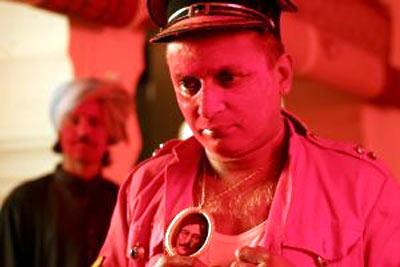
This is a long and candid interview. Piyush does not obfuscate but answers all questions directly. The site has videos and also a transcript of the interview. The one constant running through the interview is Piyush's statement that he is no genius, he does not know what his true calling is, he is constantly in turmoil over what he should be doing next. Brilliant interview of a man I consider a genius. He also does not hold out much hope of BW stopping plagiarism (a play he wrote was the basis ofr The Legend of Bhagat Singh, and he got hardly any credit!), and says he has hundreds of songs running around in his head!
Part 1
Some excerpts!
What are your views on Censorship? Many people on PFC and in general also found the line from the Ranaji song “Door des ke tower me ghus jaaye re Airplane” insensitive? Do you think audience’s correct morality and sensitivity at times interferes with an artist’s creativity?
That line “Door Des ke tower me ghus jaaye re airplane” was initially “America ke tower me ghus jaaye re Airplane” which was very direct and if there was someone who had a problem with that line, it was me. Barring me nobody had problems with that line. Not even Anurag. In fact no one. But, I had always thought that after all it was a tragedy, and I was so afraid that it might not become a mockery. So, till the last moment I was worried over this line and even tried to change it. And if a certain section of audience had problems with that line, I can totally understand their point of view and would not call their concerns misplaced. Because, when I write I get an idea about the things I am comfortable about and the things I am not. So, naturally, anything I am myself not comfortable with, it is not a big surprise that even my audience would not be comfortable with the same. So, I fretted over this line a lot and was even worried that there might be a problem associated with it. Now, 26/11 happened just before the release of Gulal, and had 26/11 not happened, it would not have been a big surprise had this song would have got banned, and in that case I would not have been able to do anything had they (censor board) decided to ban it. Also, I am not a fan of that kind of creativity where people are allowed to express just about anything in its name. I personally do not endorse that kind of creativity. But, this kind of line gave the song the starting it needed and unfortunately a better substitute did not come to my mind. Also, I did not want the song to become Anti American because I do not have anti-American feelings myself. So, in the end I believe censorship is important everywhere, because then there would be absolutely lack of control and that is something I am not very fond of.
The major influence for Gulal’s music and lyrics has been your theater days where you needed an outlet to channelize your frustration which is quite evident in the song Aarambh hai Prachand, where there is a streak of unrestrained madness in that song. And as you say you have become quite stable and have also mellowed down a bit, so do you think would it be tough for you to recreate that magic and more importantly, would it be possible for you to create the same kind of unrestrained madness in your songs?
It won’t be a problem even now. In fact, I wrote Aarambh hai Prachand for Gulal only. I can do it even now, but it would be a different from my old days where I used to compose songs spontaneously. For Black Friday’s song ‘Ruk ja re bandeh’, these guys (Indian Ocean) were composing the song and I was sitting outside, and I wrote the lines for the song. They were so amazed as to how I was able to do it, and at that time I didn’t even know that the song was extraordinary. Also, what these guys were thinking as ‘extraordinary work’, they were unaware that I have doing this kind of work since last 25 years. The song went on to become a huge hit and it is India Ocean’s most popular song till now.
After you are done with Part 1, do check out Part 2
Here are some excerpts:
Your play ‘Gagan Damam Bajyo’ on which the movie ‘The Legend of Bhagat Singh’ was made for which you had also written the dialogues. There was a lot of controversy regarding the issue of credits. Also, recently there was a row between Chetan Bhagat and Vidhu Vinod Chopra. So, what do you make out of this recent controversy when you juxtapose it with your situation? Why does it happen like that in Bollywood?
I had written the complete screenplay for the movie and I wasn’t credited for that. Yes, I was credited for the dialogues, but they could have at least shared the credit of screenplay, but that is an old thing and I don’t think much about it now. I have read that novel of Chetan Bhagat, and they (Vidhu Vinod Chopra and co.) could have given the credit for story had they wanted to, but not the entire screenplay, in my opinion. These guys have really worked hard over the screenplay and I personally don’t think the credit for screenplay should have been given to Chetan Bhagat. But, things of these sorts are not uncommon in Bollywood, I am not talking about 3 Idiots here specifically, but things of these sorts are very common here. People tamper with your scripts a lot and you can’t say anything. Moreover, there is no law and copyright actions to protect the writers, however, these days there are some work going on with respect to the copyright laws. Moreover, here people are not even concerned about these issues and they are not even bothered about what kind of movies you are going to make. For instance, nobody cares if you are making a movie on Bhagat Singh or not. Who is Bhagat Singh? All people care about is money. They made a movie on Bhagat Singh because prior to that Gadar was a big hit. Had Gadar would not have been a hit; people would not have bothered about it at all. That play (on which the movie ‘Legend of Bhagat Singh’ was made) is still with me even now and many major scenes were taken from the play itself in a completely unaltered form. So, here it is not a big thing to steal someone else’s idea or for that matter even the entire story. Plagiarism is something that will stay in Bollywood, flinching people’s credit would continue. And after a couple of jolts people learn their lessons the hard way as to how go about in protecting their works, for instance, getting educated on the importance of getting one’s work registered and how can one be strict and attentive so that no one takes away the credit.
We have been seeing of late, that there has been increase in mainstream convention defying movies, and therefore a term ‘New Wave Bollywood’ has been coined and has been used often recently. Do you think this trend is here to stay or will it fade away like the movement of 70’s?
The movement of 70’s and 80’s was more concerned with movies of Manmohan Desai where Amitabh Bachann used to rule the roost. That phase never came to stay. Before that there was a nice phase for cinema, but cinema had been distorted to a great extent in 70’s and 80’s…
(Interrupting) Actually I am talking about the cinema of 70’s and 80’s spearheaded by directors like Govind Nihlani and Shyam Benegal where they were making different kinds of movies…
What different kind of movies were they making? Nobody used to come and see those movies. It was that phase whose permanence was not even justified. I am not a big fan of that phase. Although there were people like Saaed Akhtar Mirza who used to make some quality movies, and right now we have people like Vishal, Anurag, and even his assistant, Raj Kumar Gupta, there is Dibakar, and Imitiaz Ali who is although making commercial movies but at least there is something worth watching in his movies. These guys are making quality cinema and I am very hopeful that this phase is here to stay. Most importantly, these guys are original, although even Ketan and co. were original but I do not know what happened to them with time. Dibakar has made a movie called LSD in which there are no stars, in fact why a star, there is not even a single guy whom you can recognize. But, let me tell you honestly cinema is not the major thing in my life. There is something else that is yet to come in my life, I don’t know what, but I have been made for something else too. And even now there is that same confusion in me; I am still a bit unstable. The cinema is there all right, but there is something else. I don’t’ know what that is. I am confused.
Genius or unsure of his calling? PFC interviews Piyush Mishra!
This is a long and candid interview. Piyush does not obfuscate but answers all questions directly. The site has videos and also a transcript of the interview. The one constant running through the interview is Piyush's statement that he is no genius, he does not know what his true calling is, he is constantly in turmoil over what he should be doing next. Brilliant interview of a man I consider a genius. He also does not hold out much hope of BW stopping plagiarism (a play he wrote was the basis ofr The Legend of Bhagat Singh, and he got hardly any credit!), and says he has hundreds of songs running around in his head!
Part 1
Some excerpts!
What are your views on Censorship? Many people on PFC and in general also found the line from the Ranaji song “Door des ke tower me ghus jaaye re Airplane” insensitive? Do you think audience’s correct morality and sensitivity at times interferes with an artist’s creativity?
That line “Door Des ke tower me ghus jaaye re airplane” was initially “America ke tower me ghus jaaye re Airplane” which was very direct and if there was someone who had a problem with that line, it was me. Barring me nobody had problems with that line. Not even Anurag. In fact no one. But, I had always thought that after all it was a tragedy, and I was so afraid that it might not become a mockery. So, till the last moment I was worried over this line and even tried to change it. And if a certain section of audience had problems with that line, I can totally understand their point of view and would not call their concerns misplaced. Because, when I write I get an idea about the things I am comfortable about and the things I am not. So, naturally, anything I am myself not comfortable with, it is not a big surprise that even my audience would not be comfortable with the same. So, I fretted over this line a lot and was even worried that there might be a problem associated with it. Now, 26/11 happened just before the release of Gulal, and had 26/11 not happened, it would not have been a big surprise had this song would have got banned, and in that case I would not have been able to do anything had they (censor board) decided to ban it. Also, I am not a fan of that kind of creativity where people are allowed to express just about anything in its name. I personally do not endorse that kind of creativity. But, this kind of line gave the song the starting it needed and unfortunately a better substitute did not come to my mind. Also, I did not want the song to become Anti American because I do not have anti-American feelings myself. So, in the end I believe censorship is important everywhere, because then there would be absolutely lack of control and that is something I am not very fond of.
The major influence for Gulal’s music and lyrics has been your theater days where you needed an outlet to channelize your frustration which is quite evident in the song Aarambh hai Prachand, where there is a streak of unrestrained madness in that song. And as you say you have become quite stable and have also mellowed down a bit, so do you think would it be tough for you to recreate that magic and more importantly, would it be possible for you to create the same kind of unrestrained madness in your songs?
It won’t be a problem even now. In fact, I wrote Aarambh hai Prachand for Gulal only. I can do it even now, but it would be a different from my old days where I used to compose songs spontaneously. For Black Friday’s song ‘Ruk ja re bandeh’, these guys (Indian Ocean) were composing the song and I was sitting outside, and I wrote the lines for the song. They were so amazed as to how I was able to do it, and at that time I didn’t even know that the song was extraordinary. Also, what these guys were thinking as ‘extraordinary work’, they were unaware that I have doing this kind of work since last 25 years. The song went on to become a huge hit and it is India Ocean’s most popular song till now.
After you are done with Part 1, do check out Part 2
Here are some excerpts:
Your play ‘Gagan Damam Bajyo’ on which the movie ‘The Legend of Bhagat Singh’ was made for which you had also written the dialogues. There was a lot of controversy regarding the issue of credits. Also, recently there was a row between Chetan Bhagat and Vidhu Vinod Chopra. So, what do you make out of this recent controversy when you juxtapose it with your situation? Why does it happen like that in Bollywood?
I had written the complete screenplay for the movie and I wasn’t credited for that. Yes, I was credited for the dialogues, but they could have at least shared the credit of screenplay, but that is an old thing and I don’t think much about it now. I have read that novel of Chetan Bhagat, and they (Vidhu Vinod Chopra and co.) could have given the credit for story had they wanted to, but not the entire screenplay, in my opinion. These guys have really worked hard over the screenplay and I personally don’t think the credit for screenplay should have been given to Chetan Bhagat. But, things of these sorts are not uncommon in Bollywood, I am not talking about 3 Idiots here specifically, but things of these sorts are very common here. People tamper with your scripts a lot and you can’t say anything. Moreover, there is no law and copyright actions to protect the writers, however, these days there are some work going on with respect to the copyright laws. Moreover, here people are not even concerned about these issues and they are not even bothered about what kind of movies you are going to make. For instance, nobody cares if you are making a movie on Bhagat Singh or not. Who is Bhagat Singh? All people care about is money. They made a movie on Bhagat Singh because prior to that Gadar was a big hit. Had Gadar would not have been a hit; people would not have bothered about it at all. That play (on which the movie ‘Legend of Bhagat Singh’ was made) is still with me even now and many major scenes were taken from the play itself in a completely unaltered form. So, here it is not a big thing to steal someone else’s idea or for that matter even the entire story. Plagiarism is something that will stay in Bollywood, flinching people’s credit would continue. And after a couple of jolts people learn their lessons the hard way as to how go about in protecting their works, for instance, getting educated on the importance of getting one’s work registered and how can one be strict and attentive so that no one takes away the credit.
We have been seeing of late, that there has been increase in mainstream convention defying movies, and therefore a term ‘New Wave Bollywood’ has been coined and has been used often recently. Do you think this trend is here to stay or will it fade away like the movement of 70’s?
The movement of 70’s and 80’s was more concerned with movies of Manmohan Desai where Amitabh Bachann used to rule the roost. That phase never came to stay. Before that there was a nice phase for cinema, but cinema had been distorted to a great extent in 70’s and 80’s…
(Interrupting) Actually I am talking about the cinema of 70’s and 80’s spearheaded by directors like Govind Nihlani and Shyam Benegal where they were making different kinds of movies…
What different kind of movies were they making? Nobody used to come and see those movies. It was that phase whose permanence was not even justified. I am not a big fan of that phase. Although there were people like Saaed Akhtar Mirza who used to make some quality movies, and right now we have people like Vishal, Anurag, and even his assistant, Raj Kumar Gupta, there is Dibakar, and Imitiaz Ali who is although making commercial movies but at least there is something worth watching in his movies. These guys are making quality cinema and I am very hopeful that this phase is here to stay. Most importantly, these guys are original, although even Ketan and co. were original but I do not know what happened to them with time. Dibakar has made a movie called LSD in which there are no stars, in fact why a star, there is not even a single guy whom you can recognize. But, let me tell you honestly cinema is not the major thing in my life. There is something else that is yet to come in my life, I don’t know what, but I have been made for something else too. And even now there is that same confusion in me; I am still a bit unstable. The cinema is there all right, but there is something else. I don’t’ know what that is. I am confused.
Subscribe to:
Posts (Atom)